
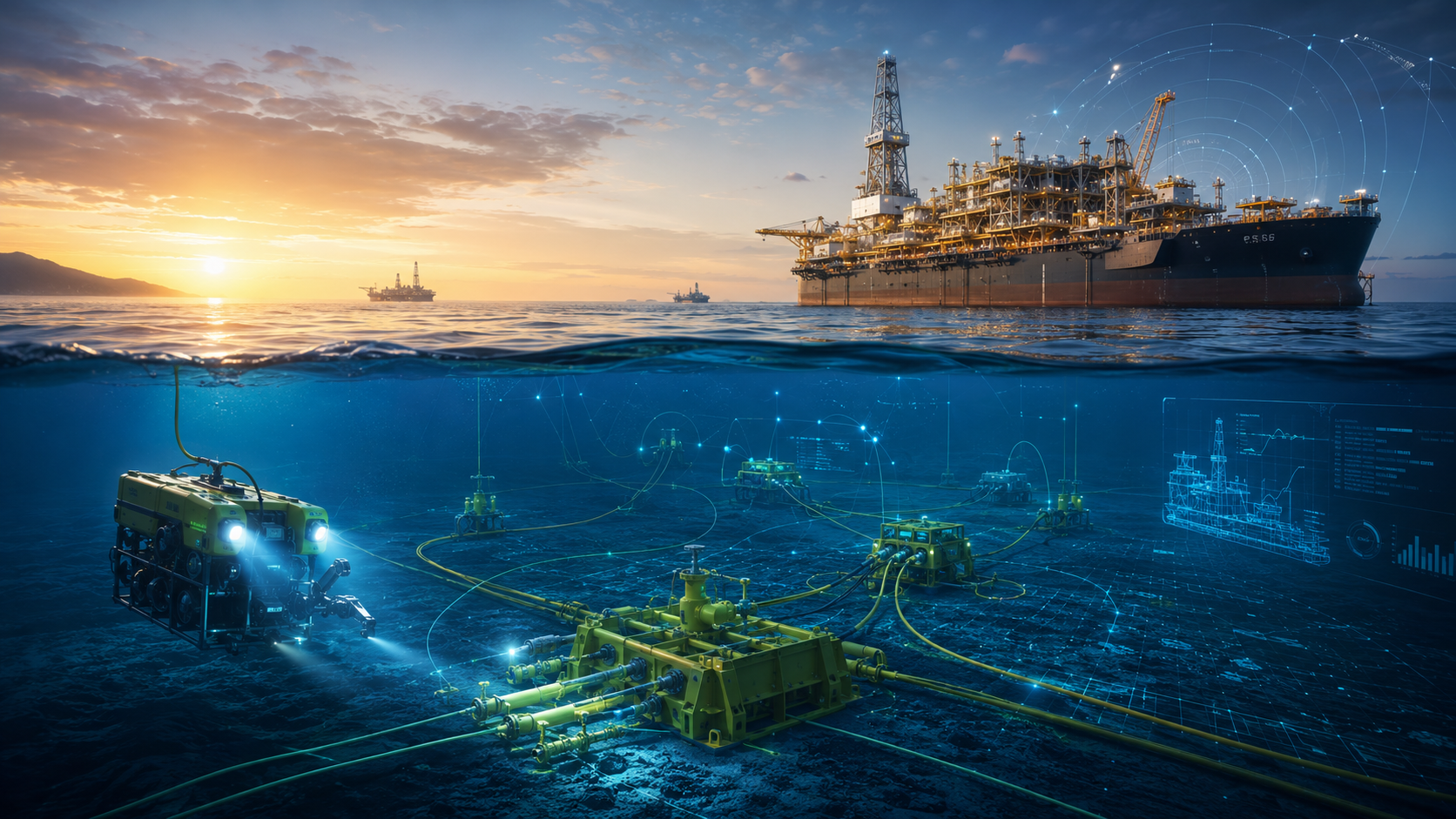
Offshore and Subsea Production Research Laboratory-Department of Ocean Engineering, Hasanuddin University
OPART Laboratory focuses on integrated research and innovation in offshore and subsea production systems, marine technology, underwater systems, offshore process engineering, digital engineering, logistics management, and sustainable ocean engineering. The laboratory combines experimental studies, computational modeling, prototype development, digital systems, and operational engineering approaches to address real-world offshore and maritime challenges.
The roadmap is centered on Offshore & Subsea Production Systems as the core engineering focus, supported by multidisciplinary research areas that integrate offshore operations, underwater technology, digital transformation, process systems, hydrodynamics, reliability engineering, logistics management, and sustainability.
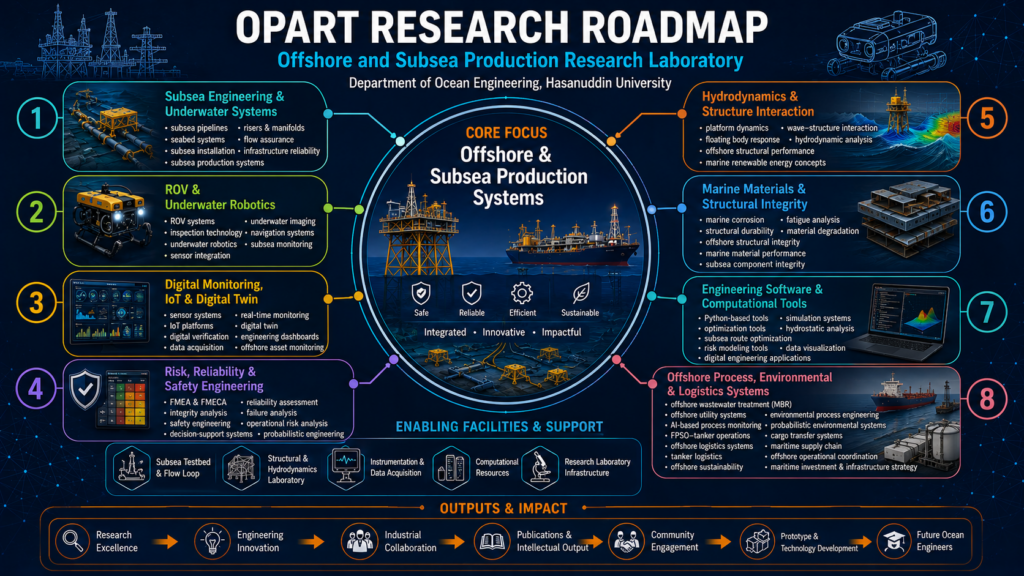
CORE RESEARCH AREAS
1. Offshore Process & Environmental Systems
This research area focuses on offshore production processes, environmental support systems, and operational systems required for sustainable offshore facilities.
Research activities include offshore process system analysis, wastewater treatment systems, offshore MBR applications, environmental performance evaluation, process reliability, and sustainability-oriented offshore operations.
Research Topics:
- offshore process systems
- offshore MBR
- wastewater treatment
- environmental support systems
- process reliability
- offshore sustainability
- production support systems
2. Subsea Engineering & Underwater Systems
This research area focuses on subsea production infrastructure and underwater engineering systems, including pipelines, risers, manifolds, seabed systems, flow assurance, and subsea installation engineering.
Research activities include subsea routing analysis, seabed interaction studies, installation risk assessment, underwater infrastructure reliability, and offshore subsea operational performance.
Research Topics:
- subsea pipelines
- risers and manifolds
- seabed systems
- flow assurance
- subsea installation engineering
- underwater infrastructure reliability
- subsea production systems
3. ROV & Underwater Robotics
This area supports the development of underwater robotic systems and marine inspection technologies for offshore and subsea applications.
Research includes underwater inspection systems, robotic navigation, imaging systems, digital inspection, sensor integration, and autonomous monitoring for offshore assets.
Research Topics:
- ROV systems
- underwater robotics
- inspection technology
- underwater imaging
- navigation systems
- subsea monitoring
- underwater sensor integration
4. Digital Monitoring, IoT & Digital Twin
This research area develops data-driven offshore engineering systems through sensor integration, IoT platforms, digital monitoring, dashboard systems, and digital twin applications.
The objective is to connect physical offshore assets with intelligent digital systems for monitoring, verification, predictive analysis, and operational decision support.
Research Topics:
- sensor systems
- IoT platforms
- real-time monitoring
- digital twin
- digital verification
- offshore asset monitoring
- engineering dashboards
- data acquisition systems
5. Risk, Reliability & Safety Engineering
This area focuses on identifying, analyzing, and mitigating operational risks in offshore, subsea, and maritime systems using systematic engineering approaches.
Research supports safer and more reliable offshore operations through reliability assessment, integrity management, failure analysis, and engineering decision-support frameworks.
Research Topics:
- FMEA and FMECA
- integrity analysis
- reliability assessment
- probabilistic engineering
- failure analysis
- safety engineering
- operational risk analysis
- decision-support systems
6. Hydrodynamics & Structure Interaction
This research area investigates the interaction between offshore structures, waves, currents, floating systems, and marine environments.
The research integrates experimental studies, numerical modeling, and hydrodynamic simulations for offshore platform performance and structural response evaluation.
Research Topics:
- platform dynamics
- wave–structure interaction
- floating body response
- hydrodynamic analysis
- offshore structural performance
- marine renewable energy concepts
7. Marine Materials & Structural Integrity
This area focuses on material performance and structural durability under harsh marine environments.
Research includes corrosion, fatigue, degradation mechanisms, offshore structural integrity, and long-term reliability assessment for marine infrastructure.
Research Topics:
- marine corrosion
- fatigue analysis
- structural durability
- offshore structural integrity
- material degradation
- marine material performance
- subsea component integrity
8. Engineering Software & Computational Tools
This area supports the development of engineering software, simulation tools, optimization systems, and computational applications for offshore and marine engineering.
Research integrates programming, simulation, numerical analysis, and visualization for solving practical engineering problems.
Research Topics:
- Python-based engineering tools
- offshore simulation systems
- optimization tools
- hydrostatic analysis
- subsea route optimization
- risk modeling tools
- data visualization
- digital engineering applications
ENABLING FACILITIES & SUPPORT
- Subsea Testbed & Flow Loop
- Structural & Hydrodynamics Laboratory
- Instrumentation & Data Acquisition
- Computational Resources
- Offshore Process & Environmental Systems Support
- Research Laboratory Infrastructure
OUTPUTS & IMPACT
The OPART Research Roadmap aims to generate:
- engineering innovation
- publication-oriented research
- industrial collaboration
- prototype development
- digital engineering solutions
- sustainability-oriented offshore systems
- community engagement
- future ocean engineering talents
This roadmap supports the long-term vision of OPART Laboratory as a multidisciplinary offshore engineering research center integrating offshore production systems, subsea engineering, digital technologies, process systems, sustainability, and intelligent maritime operations.